
Paintings that are heavily inspired by my poetry, womanhood, nature and spirituality.
Paintings that are heavily inspired by my poetry, womanhood, nature and spirituality.

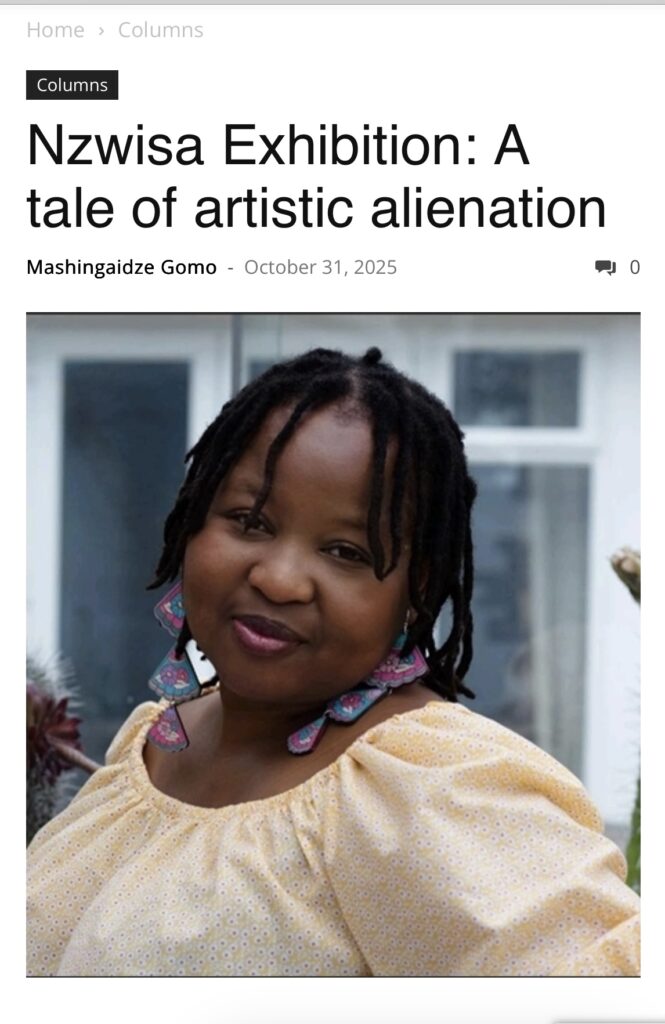
By Mashingaidze Gomo
Curated by Simphiwe Munyaradzi Moyo, it was a collection of over 30 artworks exploring ancestral memory, diasporic identity, spiritual guardianship and African womanhood. Vazhure was born in the UK in 1981 but returned to live with her grandparents in Masvingo where she did her primary and secondary education. At 18, she went back to the UK for university and has lived in Wales ever since. Both the European experience and Karanga heritage are quite palpable in a good number of her exhibited works.
The foregoing is a background that was critical to understanding the exhibition. The lived experience and knowledge base of the Zimbabweans who came to appreciate the art was equally critical. As a matter of fact, the success of any work of art very much depends on that combination. It is, ultimately, not just about what is painted or sculpted but also about who painted and why; who is viewing and what background experience and knowledge they are bringing into their interpretation. In this respect, it is fair to say that the success of any work of art comes from how much the connoisseur, enthusiast or judge brings into it. They can only take out a rough equivalent of how much they bring in. Connoisseurs invest in attachments to sentiments. They buy to store memory and values.
A two-time NAMA-winning poet and novelist, Rumbidzai began her journey as a visual artist in 2022, translating the themes of her literary work (womanhood, migration, spirituality and ancestral memory) into richly textured paintings. Working primarily with acrylic on canvas, Samantha’s vibrant impasto, impressionist, expressionist, cubist and dot-art styles reflect a poetic sensibility, rooted in African cosmology and contemporary diasporic experience. In that context, Vazhure founded Chitende Fine Art in 2023 as an outlet for her visual practice, which often merges with poetry, sound and storytelling. She continues to bridge the various disciplines with a vision that is politically conscious, spiritually grounded and artistically fearless.
The stated transition from literary work to visual expression lends credence to the choice of impasto, impressionist, expressionist, cubist and dot-art styles whose general effect is vibrant and protrusive. Vazhure intimates that “feeling the strokes and daubs of acrylic on canvas (which is a general characteristic of the styles) is gratifying to the tactile sense”. And, even though the possibility exists that these may not have been conscious choices, they could still not have been haphazard choices but rather logical developments or natural evolutions. One feels that the poet’s impasto, impressionism, expressionism, cubism and dot-art styles are not haphazard choices but organic outgrowths of her poetry or literary creations. They come across as permutations of her poetry or literary creations. They come across as free verse transmuted to 3-D illusions on canvas; like energy that cannot be created nor destroyed but simply changes form, so that the light of the sun is also electricity and heat and light again. By their very nature, impasto, impressionist, expressionist, cubist and dot-art styles are styles with the capacity to simultaneously carry the multiple meanings in the manner her poetry, and for that matter all poetry, does.
The piece Universal Oneness (2023) speaks to that. Vazhure’s paintings have appeared in Writing Woman Anthology Volume 3 by Mwanaka Publishing, Zana Zine (Mother Nature) and The Artful Prize Magazine (2024). She has exhibited with several groups in the UK, including at the prestigious Royal West of England Academy (RWA). The Nzwisa Exhibition comprises 31 limited edition prints of original paintings of acrylic on canvas and two Shona stone sculptures. The prints are 3D-scanned specifically to project the textured impressionist, expressionist, impasto, pointillist as well as cubist look of the originals. The high quality images are printed on acid-free, water-resistant, smooth fine art 320gsm giclee paper, using high dynamic range inks and delivered in robust postal tubes.
All prints come in editions of 100, are numbered, titled, dated and signed by the artist, and include a certificate of authenticity. The originals can be purchased from www.chitendefineart.com or by direct arrangements with the artist. Vazhure’s case is the reality of many ‘born-free’ Zimbabweans who have lived decades in the Diaspora. It is a reality that cannot be ignored, side-stepped or brushed aside as many are beginning to migrate back to a land and culture that, in many ways, is now only theirs by descent. Their interpretation of the ground through art is mitigated by a lived experience their audience may not be familiar with. More often, theirs actually comes across as an attempt to belong to a strange homeland after failing to belong in a foreign land. Some, among the exhibited works, show the conflict, in which case, the styles of impasto, impressionist, expressionist, cubist and dot-art also become the message. In world art history (which is euphemism for European art history) these styles did not emerge as peaceful evolutions or reform of what was already there. They came as rebellions and revolutions.
In the foregoing context, Vazhure’s multidisciplinary capacity is a special one because it can be depended upon to help unpack, for those who cannot, the identity crises that come with immigration. This is particularly in the sense in which artists often come across as a voice for the voiceless. This may, of course, sound like an overused analogy, but there still remains some truth in it. A useful alternative would be war analogy in which the artist would be both vanguard (scout) and rearguard. The vanguard is the fore party; the unit that often meets and engages the enemy for the first time and without the relevant experience to guide offence or defence. As vanguard, artists operate on a time frontier, experimenting, creating, testing, breaking barriers and presenting new worldviews. What the people popularise is what artists as rearguard preserve as traditions. Vazhure’s paintings appear to do that in many ways.
The feminism in Vazhure relates to the foregoing notions in less obvious but critical ways. The feminist element in the exhibited work is a statistic. Of the 31 paintings on exhibition, only one has an exclusively male subject while 15 include female subjects. Of the 15, a majority of nine are exclusively women. The one with the male subject is titled ‘Tiri kuenda kupi senyika?’ A hopeless man is lying down, contemplating the way forward surrounded by empty beer bottles. His distress (without a woman) is palpable. The suggestion of comparison with the Unfazed Woman, the Rebel Woman, Portrait of Harmony (2024) and How Great Thou Art (2024) is unmistakable.
The human subjects of Mwari aka Mai NdiMwari are exclusively women and children. The women are nurturing life while Kupfura Mhangura is exclusively men fashioning arms of war. But, Vazhure’s feminism is decidedly not obdurate or militant. There is no attempt to de-construct manhood. Indeed, no piece comes across as a war cry. There is no intimidation to men going through the exhibition. What one feels is, rather, an invitation to celebrate womanhood but not in the brazen sense of Judy Chicago’s Dinner Party — where dinner places were rendered as women’s genitalia. A tender evocation of intimacy, Munhu Wangu reflects the personal claim of belonging — ‘my person’. The work celebrates “the sacred bond between two people, balancing vulnerability with strength. The brushwork suggests both protection and exposure, reminding us that love is not ownership but communion.” Vazhure’s feminism is rendered as ubuntu — “balancing vulnerability with strength”. Energy Exchange (2024) sums up her humanism or ubuntu and it is concretised in the romance of Munhu Wangu and the two versions of Iwe Neni.
The statistic diminishes The Embraces of Struggle to a conflict more informed by race than gender. The artist’s position is that “love is not ownership but communion”. Munhu Wangu stands too unique to ignore. The cubist style is one-off, inviting both a closer look and a conversation. Incidentally, all of Vazhure’s human subjects are black, except the white man in The Embraces of Struggle. Even the animal subjects are African primates, Makudo eDzimbabgwe and Vhudzijena. It is a bias that celebrates the artist’s African identity without apology. Vazhure’s exhibition includes Shona stone sculpture. She feels, very strongly, that Shona stone sculpture is more Zimbabwean than painting.
The reason is, of course, not difficult to see in that African art traditions have not done a scientific analysis or break down of colour to a spectrum as wide as that done by other civilisations. We have remained stuck in analogue where others have refined it multiple shades. Tsvuku is still the name for red, orange, crimson, mauve and scarlet, among others. About her interest in Shona stone sculpture, Vazhure says she doesn’t want to be pigeon-holed. She wants to be multi-dimensional. She wants to be everything she can be and, in that spirit, she exhibited two stone pieces both done in residence under the mentorship of renowned female sculptor, Agnes Nyanhongo. These are Chembere yekwaChivi and VaChifedza Vezamo Guru. Both are in abstract and the finesse in both as firsttime pieces speaks of an easy hand on the part of Vazhure. Chembere yekwaChivi is a cast shorthand to the idiom: “Zvinhu zviyedzwa, chembere yekwaChivi yakabika mabwe ikamwa muto.”
The artist insists that Chembere yekwaChivi is not a myth but VaChifedza, the real matriarch of the Dziva people and, in that respect, her ancestor. This means that VaChifedza Vezamo Guru and Chembere yekwaChivi are one person and her ancestor. It means that both were made in homage to her. They are powerful pieces whose success lies in their organic connection to Shona orature. Stillness in Bloom is worth mentioning. It is the painting of a lone sheep in a field. She called it her favourite because it carries sentiments of the passing on of her father in 2024. The biblical reference to the ‘lost sheep’ comes to mind. And then there is something very English about the background and the colour preferences. The colour explanation came in a discussion in which Vazhure commented on how her experience of colours always transforms from nondescript to high definition every time she lands at Robert Gabriel Mugabe International Airport from the UK where the skies are almost permanently grey.
Read the review here: https://www.thepatriot.co.zw/columns/nzwisa-exhibition-a-tale-of-artistic-alienation/
by Tafadzwa Madzika-November 20, 2025
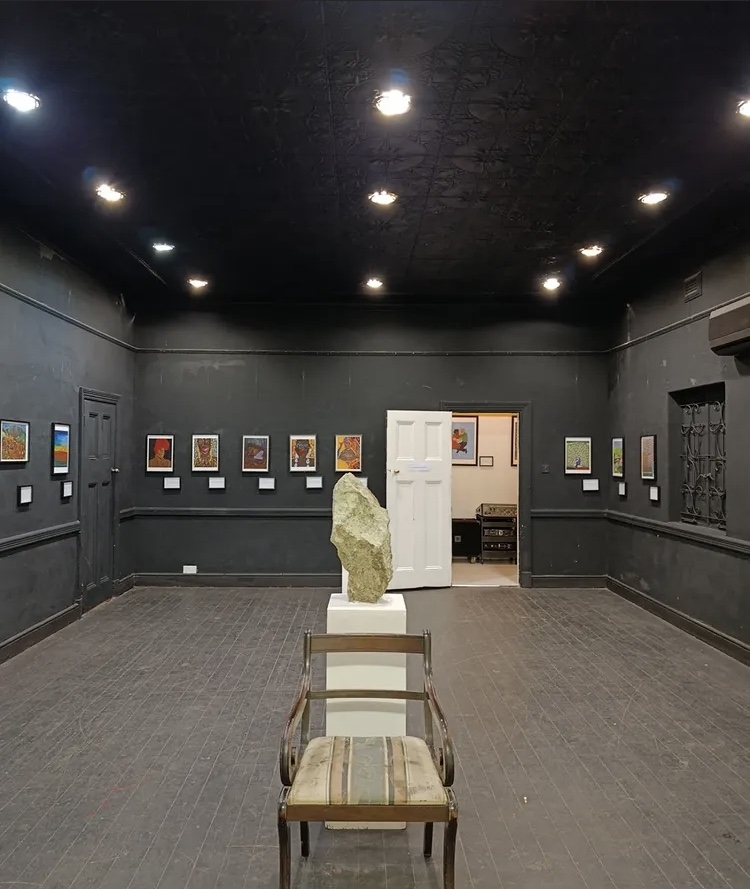
These are the questions that come to the fore of the mind when confronted by Nzwisa, a taste of the artistic creativity of Samantha Rumbidzai Vazhure’s mind. While only a showcase of the beginnings of her foray into art, Vazhure’s debut solo exhibition has a lifetime of stories.
For 9 days in October of 2025, Pamoyo Gallery was a vibrant tapestry of vivid brushstrokes and a storytelling that spoke to wandering mind, driven by a heartfelt curiosity. Across 30 artworks, Samatha Vazhure’s wears her heart on her sleeve, opening a kaleidoscopic window to herself and the ever changing understanding she has of love, heartbreak, and her culture and identity as a Zimbabwean. A writer, a poet, and a publisher, art is Vazhure’s 4th act.
Nzwisa is centred on the same medium, acrylic on canvas, yet varying painting techniques and modes of visual expression are brought into focus. From underpainting and stippling in technique, representations are a hybrid of realist and impressionist inspirations, with some being closer to the abstract. The exhibition’s seeming incongruencies is unified by a rich palette.
‘In the embraces of struggle’ sees seemingly raindrops of colour coalescing into the image of a couple holding on to each other, while their nature threatens to see them flow right off the canvas. There is a stream of questions of what these two could probably be facing. The painting shows them being of different races and well into middle ages. The struggle that comes into mind is not one just in the moment, but something that has been weathered over the years.
‘Munhu Wangu’ embeds together shapes and artistic symmetry in to depict yearning and a tender love. It is two halves that complete each other yet not identical. The representation off opposites attract, in bright striking colours.
‘Nhare’ is a representation of tradition, or rather the indigenous, the path where we came from as Shona people. The mbira dominates the canvas, a showcase of our music, there is jira reretso, a showcase of fabric and beaded bracelets that are both art and fashion. These underlying themes are complimented by artworks like ‘Mutiusenezita,’ a work that has hues that bring to mind the mythical, yet strongly tied to our reverence of our ancestral lands.
At Pamoyo Gallery, Nzwisa seemed like an act in two parts: The foyer and corridor being one, while the dark room was another. Whether surrendipitous or intentional, the artworks in the dark room had more life in them due to the black background. The colours sprang out, and a picture gallery became more than make shift but perfect for art.
The exhibition’s visually consuming moments are filtered by self evident social commentary that seems simple in inspiration but still weighty in reflection.
As an exhibition, Nzwisa goes against the grain of abstraction that has dominated many of Zimbabwean exhibitions in recent times, yet it embraces the current zeitgeist of decolonisation. It pulls in different directions, and tells multiple stories with some feeling incomplete. However it’s strongest quality is a seeking of understanding, of roots, of identity, and of love, that’s all too relatable.
Read the review on the Greedy South website: https://www.greedysouth.co.zw/2025/11/gallery-reflections-rumbidzai-vazhures.html
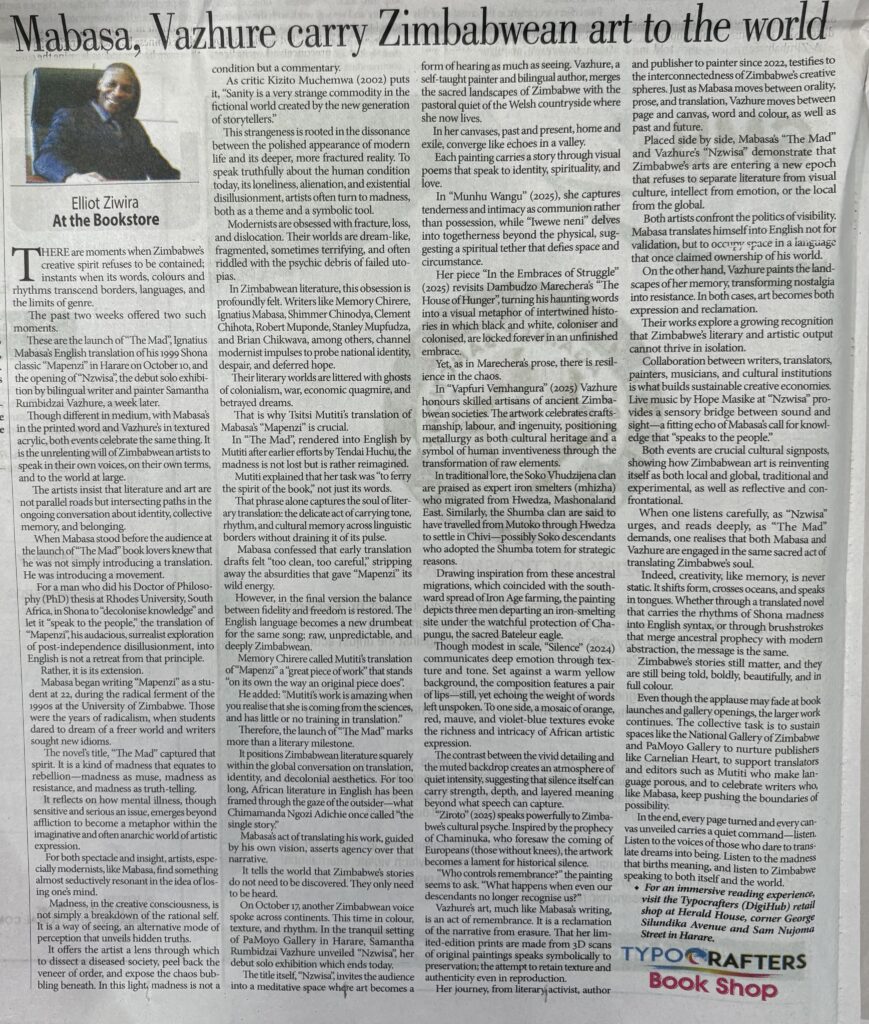
Elliot Ziwira-At the Bookstore
These are the launch of “The Mad”, Ignatius Mabasa’s English translation of his 1999 Shona classic “Mapenzi” in Harare on October 10, and the opening of “Nzwisa”, the debut solo exhibition by bilingual writer and painter Samantha Rumbidzai Vazhure, a week later.
There are moments when Zimbabwe’s creative spirit refuses to be contained; instants when its words, colours and rhythms transcend borders, languages, and the limits of genre. The past two weeks offered two such moments. These are the launch of “The Mad”, Ignatius Mabasa’s English translation of his 1999 Shona classic “Mapenzi” in Harare on October 10, and the opening of “Nzwisa”, the debut solo exhibition by bilingual writer and painter Samantha Rumbidzai Vazhure, a week later.
There are moments when Zimbabwe’s creative spirit refuses to be contained; instants when its words, colours and rhythms transcend borders, languages, and the limits of genre. The past two weeks offered two such moments. These are the launch of “The Mad”, Ignatius Mabasa’s English translation of his 1999 Shona classic “Mapenzi” in Harare on October 10, and the opening of “Nzwisa”, the debut solo exhibition by bilingual writer and painter Samantha Rumbidzai Vazhure, a week later.
Though different in medium, with Mabasa’s in the printed word and Vazhure’s in textured acrylic, both events celebrate the same thing. It is the unrelenting will of Zimbabwean artists to speak in their own voices, on their own terms, and to the world at large. The artists insist that literature and art are not parallel roads but intersecting paths in the ongoing conversation about identity, collective memory, and belonging.
On October 17, another Zimbabwean voice spoke across continents. This time in colour, texture, and rhythm. In the tranquil setting of PaMoyo Gallery in Harare, Samantha Rumbidzai Vazhure unveiled “Nzwisa”, her debut solo exhibition which ends today. The title itself, “Nzwisa”, invites the audience into a meditative space where art becomes a form of hearing as much as seeing. Vazhure, a self-taught painter and bilingual author, merges the sacred landscapes of Zimbabwe with the pastoral quiet of the Welsh countryside where she now lives. In her canvases, past and present, home and exile, converge like echoes in a valley. Each painting carries a story through visual poems that speak to identity, spirituality, and love.
In “Munhu Wangu” (2025), she captures tenderness and intimacy as communion rather than possession, while “Iwewe neni” delves into togetherness beyond the physical, suggesting a spiritual tether that defies space and circumstance.
Her piece “In the Embraces of Struggle” (2025) revisits Dambudzo Marechera’s “The House of Hunger”, turning his haunting words into a visual metaphor of intertwined histories in which black and white, coloniser and colonised, are locked forever in an unfinished embrace. Yet, as in Marechera’s prose, there is resilience in the chaos.
In “Vapfuri Vemhangura” (2025) Vazhure honours skilled artisans of ancient Zimbabwean societies. The artwork celebrates craftsmanship, labour, and ingenuity, positioning metallurgy as both cultural heritage and a symbol of human inventiveness through the transformation of raw elements. In traditional lore, the Soko Vhudzijena clan are praised as expert iron smelters (mhizha) who migrated from Hwedza, Mashonaland East. Similarly, the Shumba clan are said to have travelled from Mutoko through Hwedza to settle in Chivi—possibly Soko descendants who adopted the Shumba totem for strategic reasons. Drawing inspiration from these ancestral migrations, which coincided with the southward spread of Iron Age farming, the painting depicts three men departing an iron-smelting site under the watchful protection of Chapungu, the sacred Bateleur eagle.
Though modest in scale, “Silence” (2024) communicates deep emotion through texture and tone. Set against a warm yellow background, the composition features a pair of lips—still, yet echoing the weight of words left unspoken. To one side, a mosaic of orange, red, mauve, and violet-blue textures evoke the richness and intricacy of African artistic expression.
The contrast between the vivid detailing and the muted backdrop creates an atmosphere of quiet intensity, suggesting that silence itself can carry strength, depth, and layered meaning beyond what speech can capture.
“Ziroto” (2025) speaks powerfully to Zimbabwe’s cultural psyche. Inspired by the prophecy of Chaminuka, who foresaw the coming of Europeans (those without knees), the artwork becomes a lament for historical silence.
“Who controls remembrance?” the painting seems to ask. “What happens when even our descendants no longer recognise us?”
Vazhure’s art, much like Mabasa’s writing, is an act of remembrance. It is a reclamation of the narrative from erasure. That her limited-edition prints are made from 3D scans of original paintings speaks symbolically to preservation; the attempt to retain texture and authenticity even in reproduction. Her journey, from literary activist, author and publisher to painter since 2022, testifies to the interconnectedness of Zimbabwe’s creative spheres. Just as Mabasa moves between orality, prose, and translation, Vazhure moves between page and canvas, word and colour, as well as past and future.
Placed side by side, Mabasa’s “The Mad” and Vazhure’s “Nzwisa” demonstrate that Zimbabwe’s arts are entering a new epoch that refuses to separate literature from visual culture, intellect from emotion, or the local from the global. Both artists confront the politics of visibility. Mabasa translates himself into English not for validation, but to occupy space in a language that once claimed ownership of his world. On the other hand, Vazhure paints the landscapes of her memory, transforming nostalgia into resistance. In both cases, art becomes both expression and reclamation. Their works explore a growing recognition that Zimbabwe’s literary and artistic output cannot thrive in isolation. Collaboration between writers, translators, painters, musicians, and cultural institutions is what builds sustainable creative economies. Live music by Hope Masike at “Nzwisa” provides a sensory bridge between sound and sight—a fitting echo of Mabasa’s call for knowledge that “speaks to the people.” Both events are crucial cultural signposts, showing how Zimbabwean art is reinventing itself as both local and global, traditional and experimental, as well as reflective and confrontational.
When one listens carefully, as “Nzwisa” urges, and reads deeply, as “The Mad” demands, one realises that both Mabasa and Vazhure are engaged in the same sacred act of translating Zimbabwe’s soul. Indeed, creativity, like memory, is never static. It shifts form, crosses oceans, and speaks in tongues. Whether through a translated novel that carries the rhythms of Shona madness into English syntax, or through brushstrokes that merge ancestral prophecy with modern abstraction, the message is the same. Zimbabwe’s stories still matter, and they are still being told, boldly, beautifully, and in full colour.
Even though the applause may fade at book launches and gallery openings, the larger work continues. The collective task is to sustain spaces like the National Gallery of Zimbabwe and PaMoyo Gallery to nurture publishers like Carnelian Heart, to support translators and editors such as Mutiti who make language porous, and to celebrate writers who, like Mabasa, keep pushing the boundaries of possibility.
In the end, every page turned and every canvas unveiled carries a quiet command—listen. Listen to the voices of those who dare to translate dreams into being. Listen to the madness that births meaning, and listen to Zimbabwe speaking to both itself and the world.
Read the full review on the Herald Online website: https://www.heraldonline.co.zw/mabasa-vazhure-carry-zimbabwean-art-to-the-world
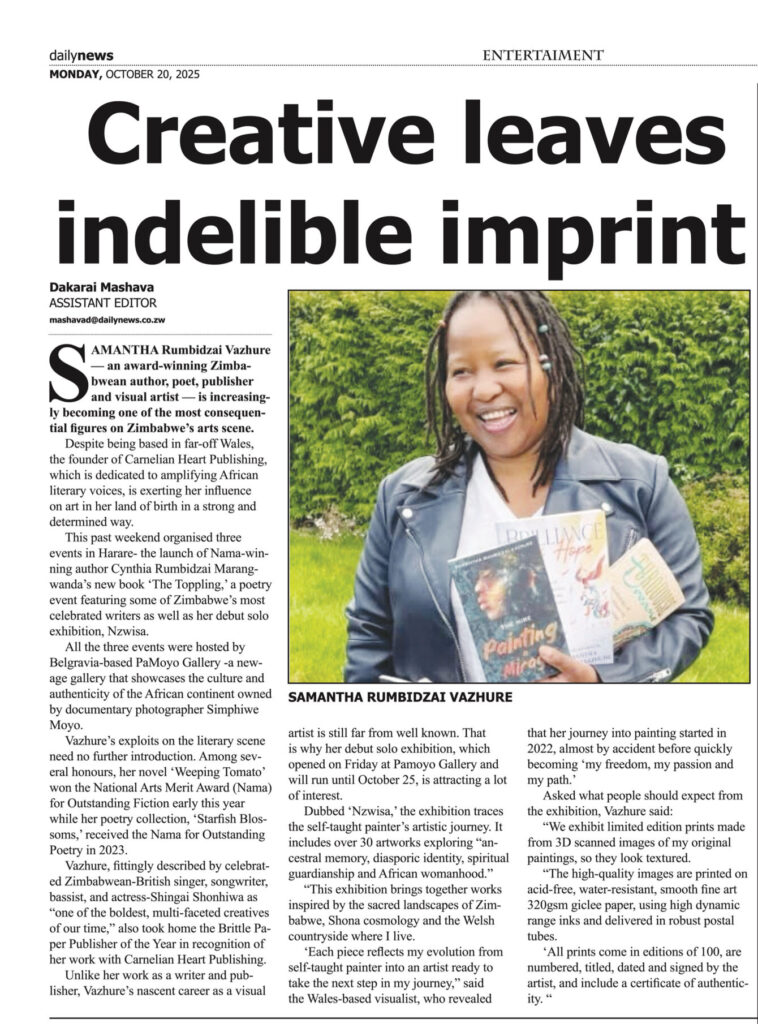
Read the review on the Daily News website: https://dailynews.co.zw/creative-leaves-indelible-imprint
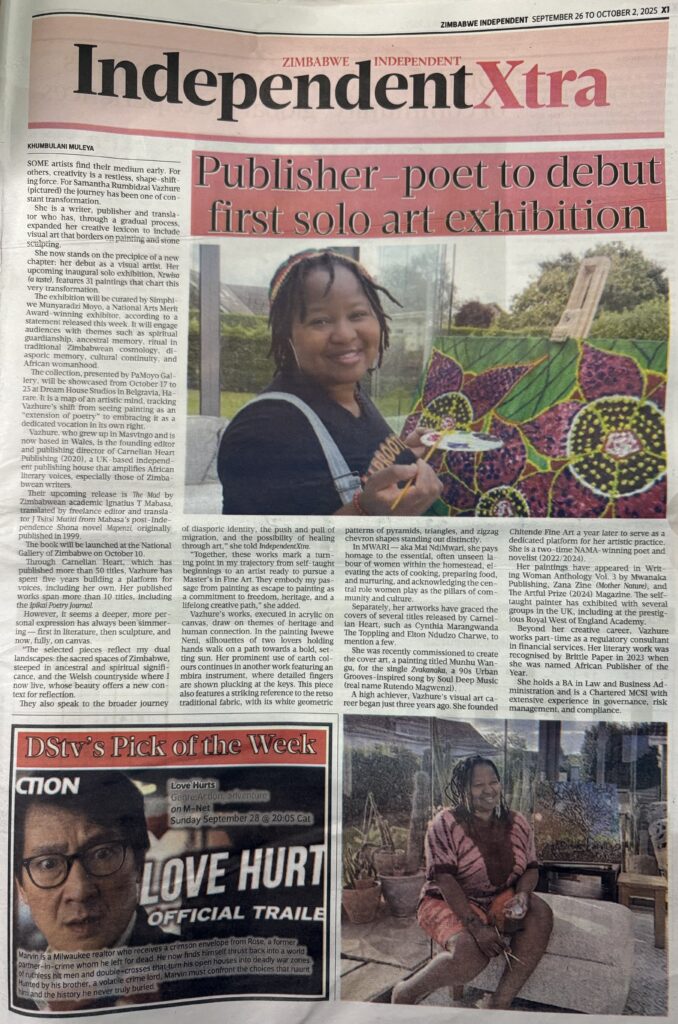
She is a writer, publisher and translator who has, through a gradual process, expanded her creative lexicon to include visual art that borders on painting and stone sculpting.
She now stands on the precipice of a new chapter: her debut as a visual artist. Her upcoming inaugural solo exhibition, Nzwisa (a taste), features 31 paintings that chart this very transformation.
The exhibition will be curated by Simphiwe Munyaradzi Moyo, a National Arts Merit Award-winning exhibitor, according to a statement released this week. It will engage audiences with themes such as spiritual guardianship, ancestral memory, ritual in traditional Zimbabwean cosmology, diasporic memory, cultural continuity, and African womanhood.
The collection, presented by PaMoyo Gallery, will be showcased from October 17 to 25 at Dream House Studios in Belgravia, Harare. It is a map of an artistic mind, tracking Vazhure’s shift from seeing painting as an “extension of poetry” to embracing it as a dedicated vocation in its own right.
Vazhure, who grew up in Masvingo and is now based in Wales, is the founding editor and publishing director of Carnelian Heart Publishing (2020), a UK-based independent publishing house that amplifies African literary voices, especially those of Zimbabwean writers.
Their upcoming release is The Mad by Zimbabwean academic Ignatius T Mabasa, translated by freelance editor and translator J Tsitsi Mutiti from Mabasa’s post-Independence Shona novel Mapenzi, originally published in 1999.
The book will be launched at the National Gallery of Zimbabwe on October 10.
Through Carnelian Heart, which has published more than 50 titles, Vazhure has spent five years building a platform for voices, including her own. Her published works span more than 10 titles, including the Ipikai Poetry Journal.
However, it seems a deeper, more personal expression has always been simmering-first in literature, then sculpture, and now, fully, on canvas.
“The selected pieces reflect my dual landscapes: the sacred spaces of Zimbabwe, steeped in ancestral and spiritual significance, and the Welsh countryside where I now live, whose beauty offers a new context for reflection. They also speak to the broader journey, the push and pull of migration, and the possibility of healing through art,” she told Independent Xtra.
“Together, these works mark a turning point in my trajectory from self-taught beginnings to an artist ready to pursue a Master’s in Fine Art. They embody my pas- sage from painting as escape to painting as a commitment to freedom, heritage, and a lifelong creative path,” she added.
Vazhure’s works, executed in acrylic on canvas, draw on themes of heritage and human connection. In the painting Iwewe Neni, silhouettes of two lovers holding hands walk on a path towards a bold, setting sun. Her prominent use of earth colours continues in another work featuring an mbira instrument, where detailed fingers are shown plucking at the keys. This piece also features a striking reference to the retso traditional fabric, with its white geometric
In MWARI-aka Mai NdiMwari, she pays homage to the essential, often unseen labour of women within the homestead, elevating the acts of cooking, preparing food, and nurturing, and acknowledging the central role women play as the pillars of community and culture.
Separately, her artworks have graced the covers of several titles released by Carnelian Heart, such as Cynthia Marangwanda The Toppling and Elton Ndudzo Charwe, to mention a few.
She was recently commissioned to create the cover art, a painting titled Munhu Wangu, for the single Zvakanaka, a 90s Urban Grooves-inspired song by Soul Deep Music (real name Rutendo Magwenzi).
A high achiever, Vazhure’s visual art career began just three years ago. She founded Chitende Fine Art a year later to serve as a dedicated platform for her artistic practice. She is a two-time NAMA-winning poet and novelist (2022/2024).
Her paintings have appeared in Writing Woman Anthology Vol. 3 by Mwanaka Publishing, Zana Zine (Mother Nature), and The Artful Prize (2024) Magazine. The self-taught painter has exhibited with several groups in the UK, including at the prestigious Royal West of England Academy.
Beyond her creative career, Vazhure works part-time as a regulatory consultant in financial services. Her literary work was recognised by Brittle Paper in 2023 when she was named African Publisher of the Year.
She holds a BA in Law and Business Ad- ministration and is a Chartered MCSI with extensive experience in governance, risk management, and compliance.
By KHUMBULANI MULEYA
ZIMBABWE INDEPENDENT SEPTEMBER 26 TO OCTOBER 2, 2025